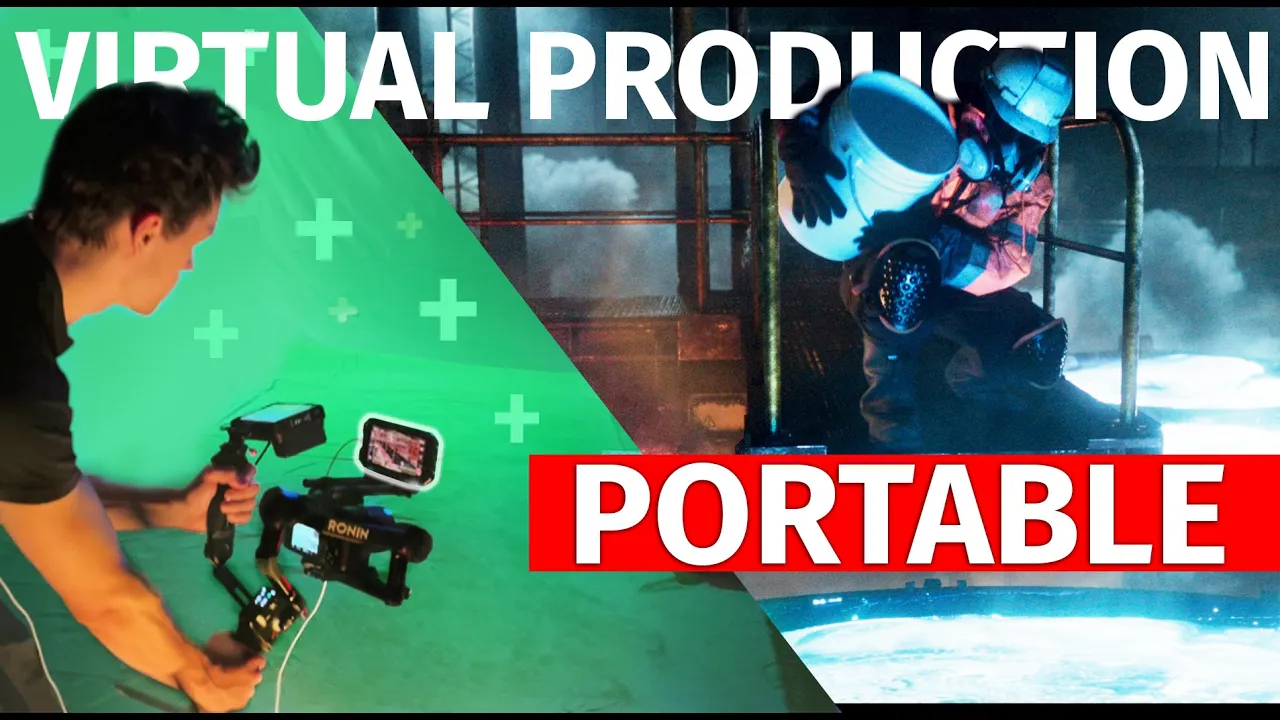
Alex Hanneman turned a disused barn into a virtual production stage with Jetset Cine, an iPhone, and a lot of resourcefulness, proving feature-grade VFX does not need a multi-million-dollar LED volume.
The Project
Alex set out to prove that virtual production does not require a multi-million-dollar LED stage, just craftiness and willpower. Rather than rent a green screen stage, he used his wife’s grandparents’ barn, a large, dark, disused top floor, which is exactly the kind of space a cinematic backlit shot needs: enough room to push the actor far from the green screen so the screen can be lit while the actor stays dark. The whole production runs on a small footprint: Nuke, Blender, Jetset on an iPhone, and a Sony FX3 (the same camera used to shoot The Creator).
The Workflow
Set building came first, on a budget. A real factory catwalk was expensive and hard to find, so Alex improvised: rubber mats whose surface already read as catwalk grating, raised off the floor on cheap wood painted black and braced across two parallel ladders, leaving the gap underneath that lets light come from below and keeps the actor’s feet off the green screen. He kit-bashed the surrounding CG environment from large, medium, and small assets, like building with Lego, composing factory catwalks for layered 3D parallax. A clever economy: the floor pieces repeat, so the same virtual floor stands in for many different sections of the factory simply by reusing and reorienting it.
Then practical effects, to give the CG life. Dull CG usually comes from a lack of motion, so Alex layered real elements: smoke shot in ProRes RAW on the FX3 with smoke machines and dry ice against black (feeding his own reusable VFX element library), EmberGen for the thick, self-shadowing smoke that needs controlled density and rim light, and acid barrels created by filming glow sticks and glow-in-the-dark paint mixed into liquid soap, agitated with an air compressor under black light, then key-mixed in Nuke and wrapped onto proxy geometry from Blender.
The virtual production pass tied it together. Alex controlled his rig, his lights, and the virtual scene all from the iPhone, relighting the actor to match their orientation in the CG set. In Jetset he loaded the CG set, placed the origin (snapping the scene to the bottom corner of the catwalk), and rotated the virtual set to shoot it from different angles, using the green screen key or AI matte to previsualize each shot. The feature he singles out is occlusion: unlike an LED background, Jetset uses the phone’s LiDAR so CG objects can pass in front of the actor, letting him direct and discover shots like a filmmaker rather than staring into a green void.
For the Cine version, the app tracks the cinema camera by calculating the offset between the iPhone and the cine lens through a quick lens calibration (a small adapter mounts temporarily to compare both cameras, then comes off). A LiDAR scan of the real set can be overlaid on the virtual set to help align tracks later. Once filming starts, the 3D data is packaged and exported to any 3D software, and Lightcraft’s Autoshot handles the back-end work that turns this from a single-angle tracking app into a full virtual production pipeline.
The Takeaway
A disused barn, a cinema camera, and an iPhone were enough to produce feature-level visual effects. The value Alex points to is twofold: creatively, he can move through a real-time scene instead of shooting blind into green, and technically, Autoshot strips out the tedious manual tracking on the back end. It is the controlled-set companion to his Icelandic Dragon shoot, the same toolset proving itself in a very different setting.


