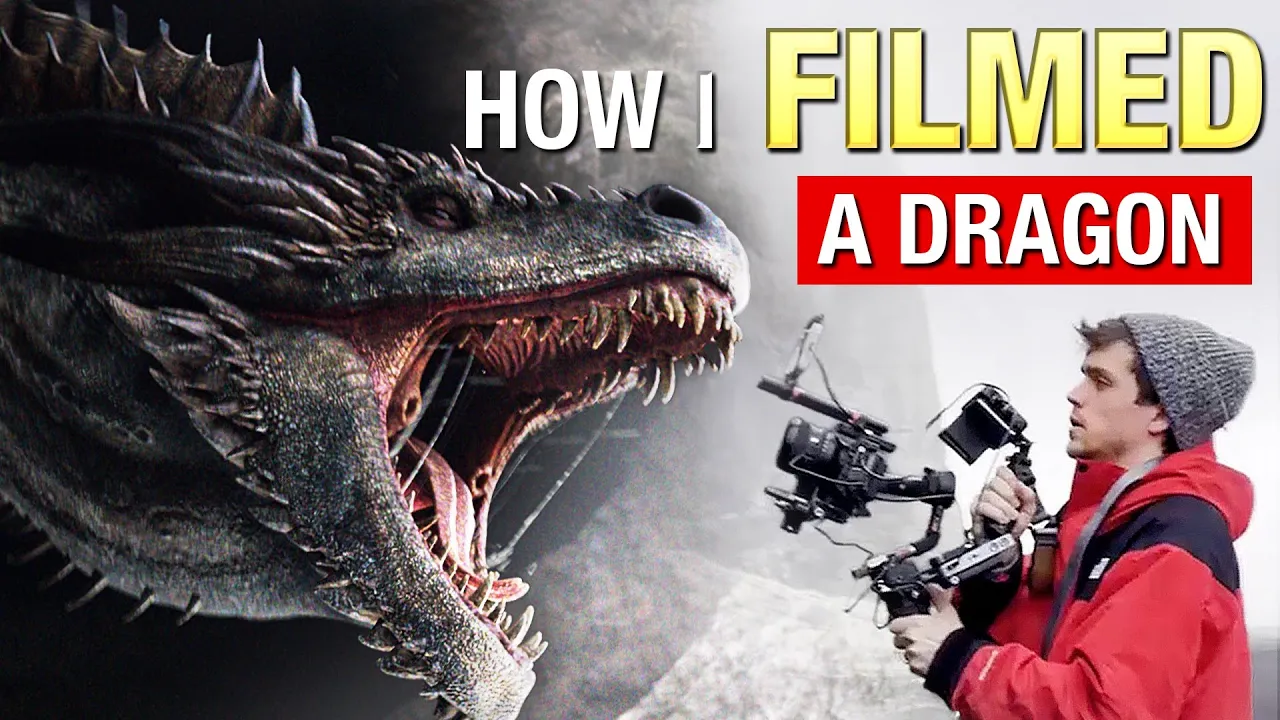
A CG dragon, a real cave in Iceland, and a one-shot test of how far a small team can push virtual production with Jetset.
The Project
Alex set out to challenge a common assumption: that virtual production means an LED stage. Jetset is portable, so it travels off the stage and into real, uncontrolled environments. His test was deliberately hard. Fly to a cave on Iceland’s southern coast (nicknamed Yoda Cave), place a hero CG dragon inside it, and capture the shots live, reacting to the creature in real time on the monitor. If it worked, it would show that the right team and the right tools can rival a large VFX studio without a seven-figure budget or waiting for permission.
The dragon was a high-resolution, fully rigged sculpt from iCandy XYZ, animated by creature artist Martin Lays.
The Workflow
Jetset flips the usual VFX order. Instead of shooting an empty plate and adding CG later, Alex animated the dragon first so he could frame to the creature on location. That created a pre-production problem: he needed a model of the cave before he landed in Iceland. He built a rough version with photogrammetry from tourist photos and videos pulled online, then refined it when a Lightcraft co-founder’s family in Iceland captured on-site measurements. From the millions-of-polygon hero asset, he generated a lightweight proxy mesh that runs in real time on an iPhone.
On location, the iPhone ran Jetset for tracking and live preview while a Sony FX3 captured the footage. After a quick lens calibration, the iPhone tracked the FX3 and overlaid the dragon directly on the cinema feed. For on-set data, Alex captured HDRIs and scanned the cave interior with an XGrids handheld LiDAR scanner, producing a dense point cloud, a mesh, and a Gaussian splat precise enough to refine tracking and drive accurate lighting in post.
Each time Alex recorded a setup, Jetset saved that virtual camera to match the real camera’s position, so the scene arrived in post already aligned, footage and creature together. He finished the shots in Nuke to reach feature-level quality.
The shoot nearly fell apart. A nearby production had reserved the location for several days, the team’s car battery died and cost another day and a half, and the cave was closed to the public when they arrived. They waited past midnight for the site to clear and used Iceland’s midnight-sun blue hour to get the shot. One window, one shot.
The Takeaway
The result is a full sequence, not a single hero frame, captured live in a location no LED stage could replicate. It is a concrete proof point for what Jetset is for: portable, real-time virtual production that lets a small team frame and shoot CG on location and walk away with shots already aligned for finishing. As Alex puts it, you no longer have to wait for the permission slip.


